

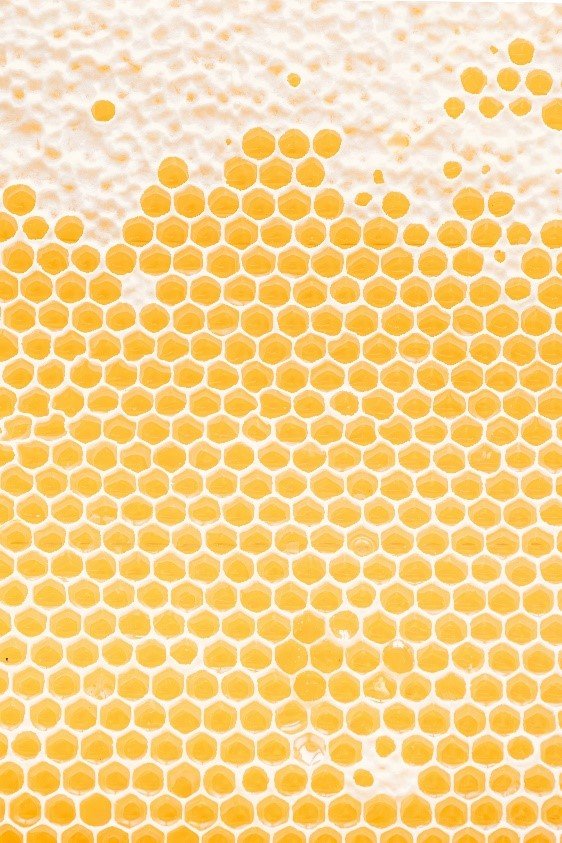

Honeycomb is no doubt a marvel. Its perfection is in the details and the details are impeccable indeed.
Honeybees are a masterpiece of nature. They are stunning due to their work ethic, the honey they produce, and their complex social structure. Another truth about honeybees is that they are brilliant mathematicians and architects. Von Frisch argues that bees can determine angles. However, a specific mathematical speciality of the bee exists in the closest thing to them: the hive. Like all other beings, bees have basic needs – food and shelter to exist. The hive is not just a home for honeybees but a storage place for their honey. Since the hive is extremely important for their survival, the hive’s architecture is beyond human thinking. If you have ever encountered a honeycomb, you will notice that it has a tightly packed hexagonal design. But the question is, why did honeybees make a hexagonal design?
To understand this, you need to think of certain factors, including a secure place where they can store nectar until it converts into honey. This highlights the need of an efficient space like storage cells. Each cell must be big enough to house a honeybee and her nectar. The cell acts as both a honeybee jar and the personal room of the bee in the hive. Bees don’t pick things with their arms or beaks, but they are able to produce wax, which takes quite an effort. For example, according to Sue Corby (a bee researcher at Washington State University), one bee needs to consume 8 ounces of honey to produce 1 ounce of wax, so there is limited room for wastage. Therefore, bees need a design that enables them to store the maximum amount of honey with the least amount of wax. But which shape provides maximum space?
The honeycomb shape is basically a mathematical inquiry. It is often called the honeycomb conjecture in mathematics, and it took thousands of years for mathematicians to solve and until recently, Hales, in his seminal paper, informed that the hexagon is the most efficient shape. The bees knew this that mathematicians know after thousands of years. If you have remember James Web Space Telescope it also has hexagon shapes on it because hexagon is optimal for collecting more light and use less material. But how do bees build a hexagon structure? Gharooni-Fard, in their most recent study, printed a 3D plastic honeycomb structure with a hexagonal shape having cells of different sizes – some cells are large, some are even larger, and some are smaller. When the structure was introduced to bees with an X-ray microscope attached, the researchers found that the bees created their own structure onto the 3D one given to them with three techniques: merging, tilting, and layering. For example, merging was used to merge foundation cells that are too small compared to the natural ones, tilting was used to shrink larger cells into smaller ones, and layering was used to create a layer in very large cells.
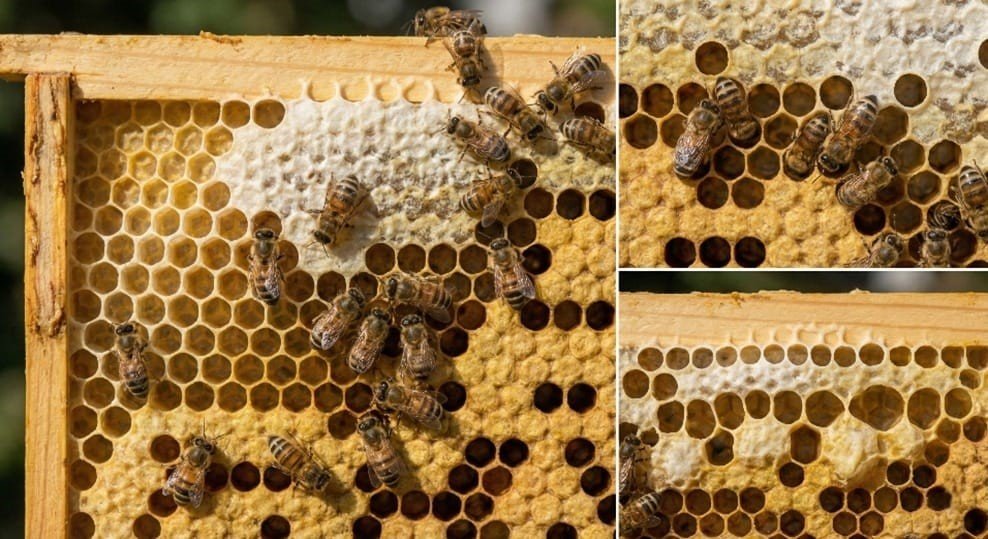
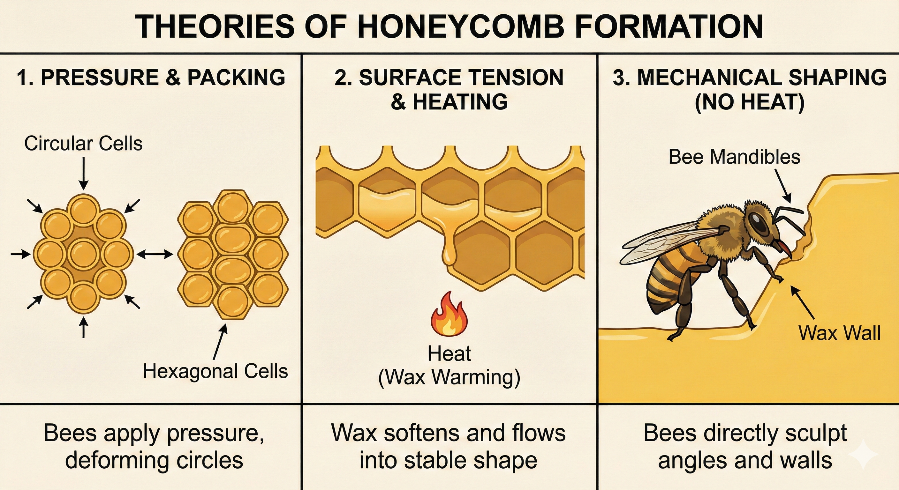
Still, there is debate among biologists about how bees build hexagons from scratch. One view is that bees may begin with a circle, and when each honeybee applies pressure on cells, they transform circles into texicans. Another view argues that surface tension and heating of the wax create a hexagonal shape. The recent view suggests that bees do not heat wax and puts forward an alternative explanation, as per the mechanical shaping of the cells. Whether bees use some sort of biological engineering or physical forces, the hexagon formation is debatable.
It appears that bees have instinctive behavior that scientists have yet to discover. Whatever the explanation is the honeycomb is a beautiful and perfect creation, but a complex one as well when you look more closely.